


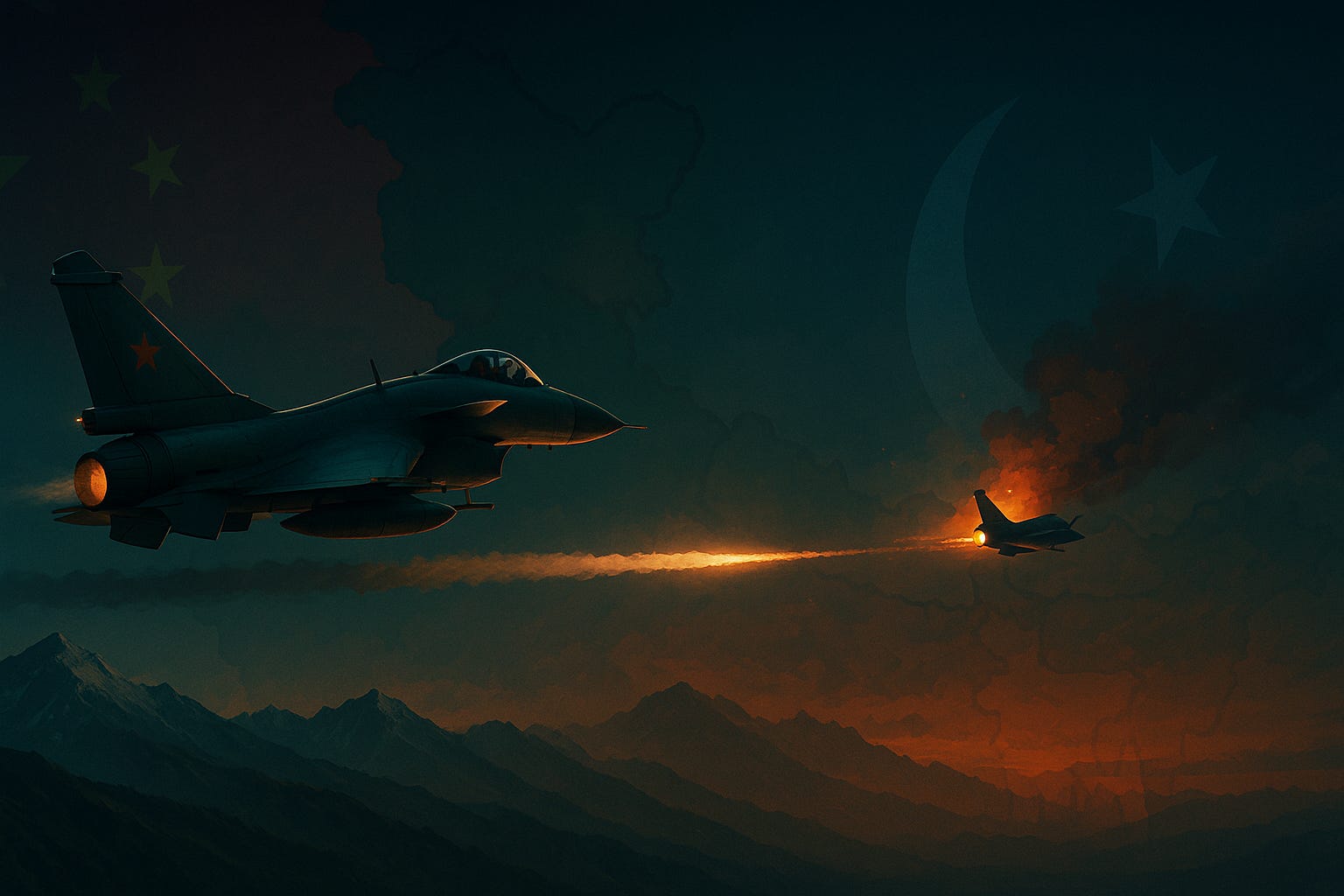
On May 6, Indian fighter jets bombed Pakistani targets. The strike was retaliation for a terrorist attack in Kashmir, where non-Muslim civilians were executed point-blank. It was a brutal, sectarian killing.
India claimed complete operational success. Mission accomplished, terrorists killed, targets hit. But within hours, that version of the story began to collapse. Twitter, Discord, and OSINT researchers who were tracking the conflict started to share wreckage photos of what appeared to be downed aircraft on Indian soil. Pakistani officials went on CNN and claimed they had downed two jets. By sunset, Pakistan had raised that number to five.
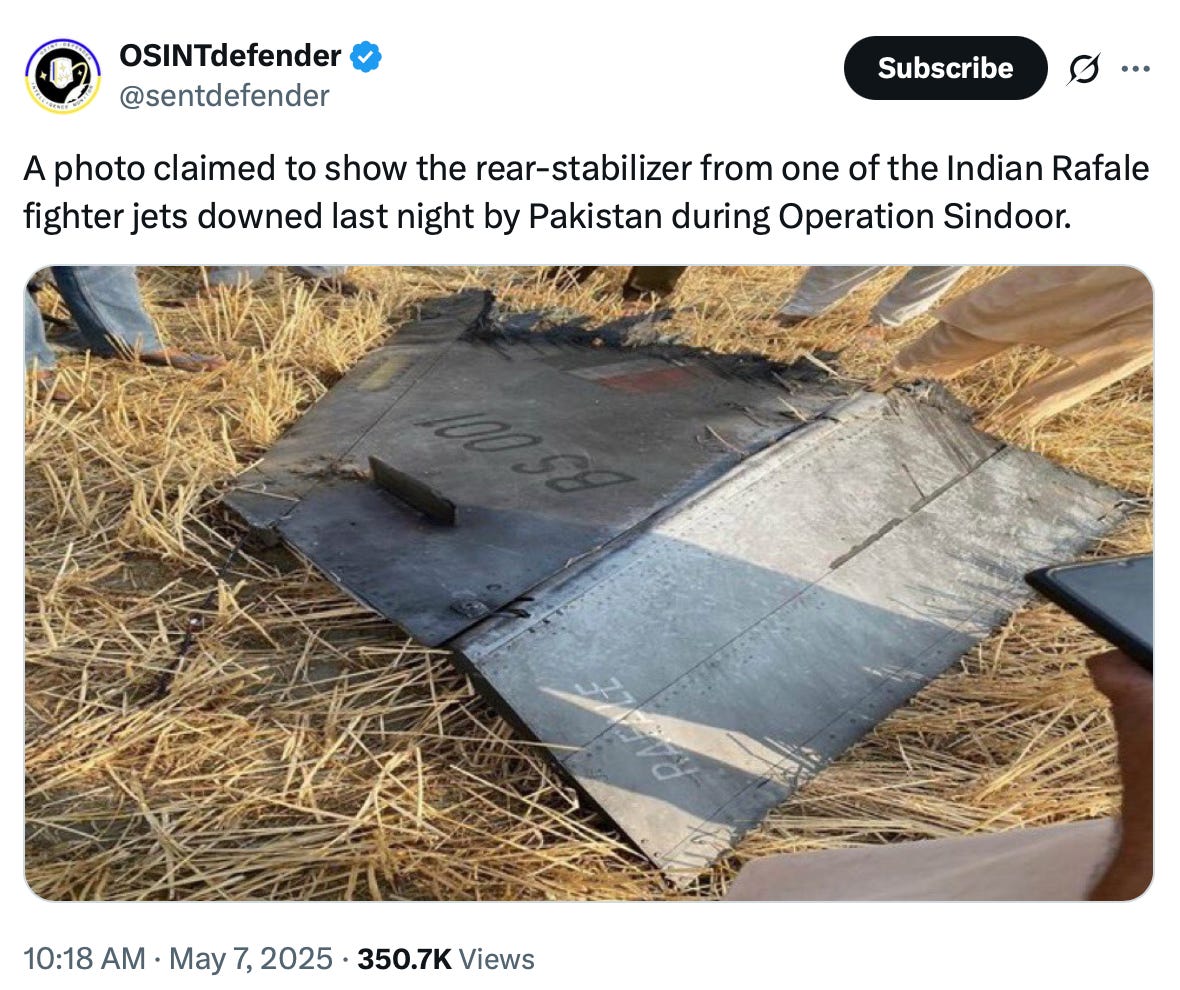
Initially, casual observers did not take the Pakistani claims seriously. Both India and Pakistan are known for spinning baseless claims and propaganda to project strength. However, despite this, this time the evidence seemed to tilt in Islamabad’s favor.
By the next morning, multiple open-source analysts had confirmed that at least two Indian aircraft had been destroyed. Satellite imagery showed possible crash sites. Locals reported immediate lockdowns by Indian military convoys that had secured the crash sites within hours.
Multiple French intelligence officials confirmed to CNN immediately in the hours after the air conflict erupted that at least one of the downed aircraft was a French-manufactured 4.5th generation fighter aircraft, the Rafale F3R. Nearly three weeks later, the official line from the French government is that they are still “investigating” whether multiple Rafale aircraft were shot down, and have yet to issue a definitive public statement. India, for its part, has only now cautiously acknowledged losing aircraft in the conflict, but refused to specify how many or what type.
France sells the F3R under strict confidentiality agreements to customer-states that likely limits public disclosure. Even when the truth surfaces, it’ll be buried under diplomatic fog.
As the news spread, a much deeper question began to emerge...
How did Pakistan, a country in economic ruin with a defense budget roughly fifty times smaller than India’s, pull this off?
Short answer: they didn’t. Not on their own, at least. They had help… from China.
This Was a Proxy Demo
Pakistan’s military hasn’t been operating on its own for years. Up until 2010, its primary arms supplier was the United States. But after the Abbottabad raid in 2011, relations between the two countries began to deteriorate rapidly. By 2016, Washington had fully suspended arms sales to Pakistan. This created a vacuum, and China moved quickly to fill it.
Through a new initiative called the China-Pakistan Economic Corridor (CPEC), Beijing transformed Pakistan into a client state. The CPEC allowed China to dump billions into Pakistan in the form of economic aid, military assistance, infrastructure, and, most importantly, weapons.
China sold cutting-edge weapon systems to Pakistan, including J-10C fighters, PL-15E air-to-air missiles, electronic warfare suites, and armor. In exchange, China gained access to a strategic, nuclear-armed ally with a long, volatile border with India.
The recent modernization of Gwadar Port, in which China spent billions on upgrades, turning Gwadar from a modest commercial port into a massive deepwater facility with strategic reach, was part of this larger military calculus. China wasn't just investing in Pakistani infrastructure; it was co-opting it to guarantee its own national security.
And almost all of the Chinese technology Pakistan procured was on full display during the recent Kashmir conflict. China may not have been on the battlefield — but its weapons were. And they got the kind of field test against a NATO-grade platform that money simply could not buy.
At the center of the engagement from the Pakistani side was the Chinese J-10C — the export variant of one of China’s newer multirole fighters — facing off against India’s Rafale F3Rs, the crown jewel of the Indian Air Force and one of the most advanced NATO-grade aircraft currently in service. The F3R is frequently compared to the F-35 for its agility, targeting, and versatility — and yet, in this battle, it didn’t hold the advantage.
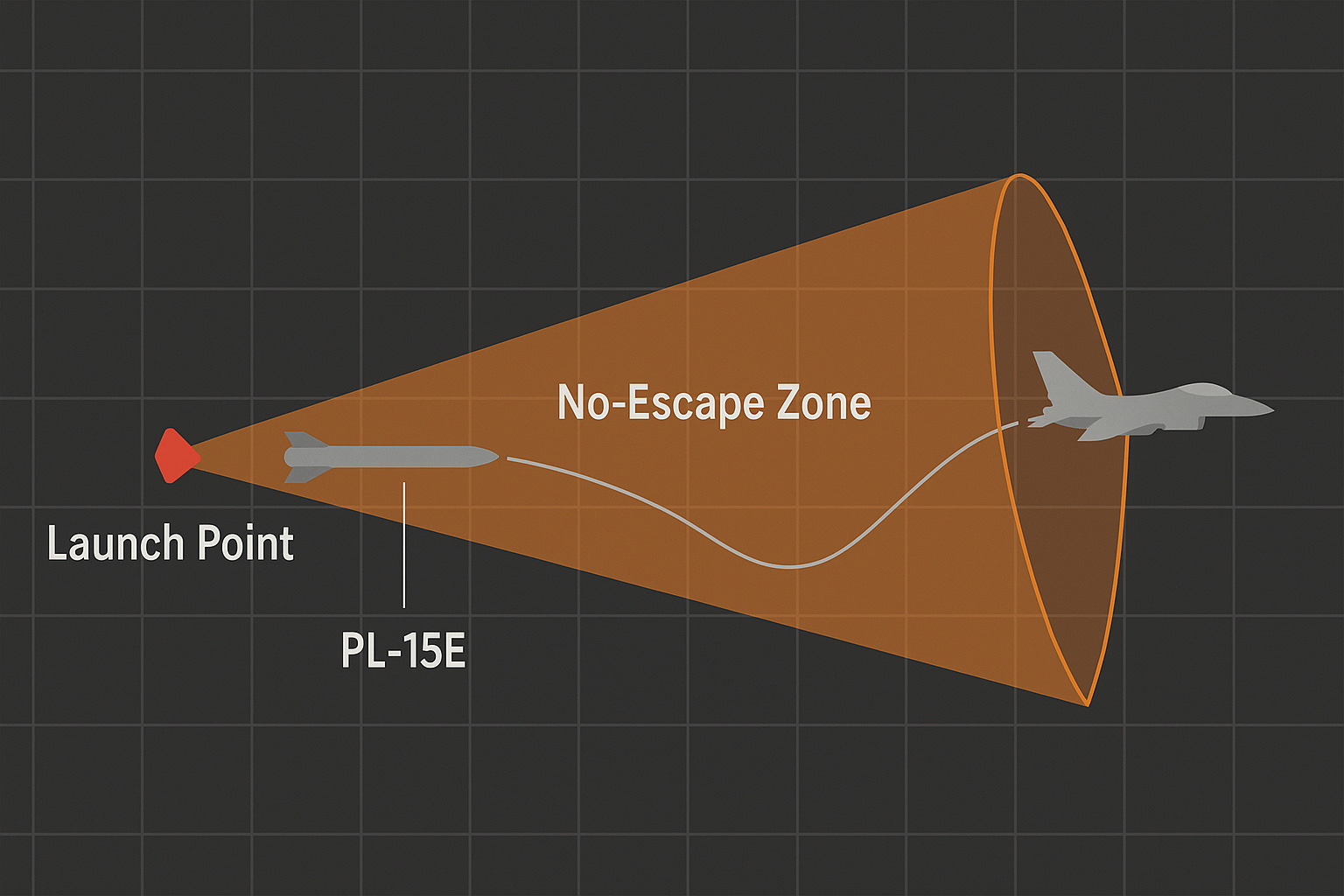
Pakistan and India exchanged missiles at ranges exceeding 100 kilometers. Nobody entered enemy airspace. Because of the nature of modern air combat, nobody needed to. That's where the Chinese-manufactured PL-15E hypersonic missile came in.
The PL-15E is the export variant of a much more capable domestic missile. It uses a dual-pulse engine, AESA radar, and has a range of 145km (the range of the domestic version is even longer at 300km). Once fired, it creates what defense analysts call a “No-Escape Zone” which almost guarantees a direct hit — regardless of how aggressively the enemy aircraft maneuvers or tries to evade.
For both the J-10C and the PL-15E, this was their first use in an active combat engagement. And the trial gave China exactly the validation it had been seeking: their J-10Cs had downed a top-tier NATO jet in real combat. Their system worked.
And Beijing was elated. According to a report from the Telegraph:
At 4am on Wednesday, China’s ambassador to Pakistan hurried to the foreign ministry to celebrate an unprecedented military success.
Pakistan had reportedly shot down several Indian aircraft in the hours before using Chinese J-10C fighter jets.
“Our jet fighters… shot down three Indian Rafales, three Rafales [that] are French,” Ishaq Dar, Pakistan’s foreign minister, told parliament on Wednesday. “Ours were J-10C.”
The Chinese delegation, roused from their sleep by the outbreak of conflict between two nuclear-armed nations, was thrilled with the success of the Pakistani defence, Mr Dar said.
“Being a friendly nation, they expressed great happiness.”
This wasn’t just a battle. It was a live-fire demo. China didn't just sell Pakistan hardware. They were intimately involved in training their allies, helping them use their platforms, and now, as a result, have been able to prove reliably that their technology works against Western equivalents.
And this partnership seems to only be deepening. In the weeks since the air conflict ended, China has fast-tracked delivery of the eponymously named J35A stealth fighter, an aircraft that is vastly cheaper and has aggressively borrowed design cues and has similar capabilities to the US-made F-35.
India’s Mess Is the West’s Mirror
India is the largest importer of defense technology in the world, but its military procurement is an unmitigated disaster. Its arsenal is cobbled together from a dozen different countries — Russia, France, Israel, the U.S., Spain, and others. There’s no coherent doctrine, no standardized logistics, and no scalable domestic manufacturing. On paper, it looks like strategic diversification. In practice, it’s absolute chaos.
And unfortunately, India isn’t some bizarre exception, either. It’s a preview.
Zoom out, and you’ll see the same vulnerabilities spreading across the Western defense establishment. Our supply chains are brittle. Our surge capacity is nonexistent. We’re over-regulated, underdeveloped, and dependent on foreign adversaries for basic supply chain inputs — from rocket fuel to semiconductors to high-end drones. Even in Ukraine, where drone warfare has taken center stage, many critical components still come from Chinese factories.
Meanwhile, China is scaling. They’re not just building for themselves — they’re building for export. Their allies can field fleets in months, while we can’t deliver basic munitions on time.
This isn’t just inefficient — it’s dangerous. And the gap is accelerating… an ominous sign for where we are headed.
China Can Build. The West Can’t. That’s the Problem.
The PLA Navy now launches more ship tonnage annually than the U.S. and UK combined. Chinese drone factories are outproducing their Western equivalents by a factor of ten. And the Kashmir engagement may have been China’s most successful marketing pitch yet — a dogfight turned weapons expo.
The West — especially the U.S. — may still hold the edge… for now. American defense systems are highly integrated. Our stealth tech, kill-chain doctrine, and AI-enhanced targeting remain best in class. The DoD’s push toward networked warfighting, mocked in the early 2000s, is now the standard everyone wants and is racing to copy.
But even the best systems fail if they can’t be replaced.
The U.S. keeps betting on a few “exquisite” platforms — the F-22, the Zumwalt-class, whatever NGAD turns into. But by building singular advanced systems, we have fooled ourselves into complacency while ignoring one of the new fundamental truths of modern warfare: quantity matters.
If your adversary can lose ten units and come back with twenty, your technological superiority will eventually mean nothing. And if you lose ten and can't even replace one in an all-out war? You've guaranteed defeat before the conflict even begins.
The Kashmir conflict marks the end of any illusion about a vast technological gap between Western and Chinese capabilities. That advantage is swiftly disappearing. Chinese systems have not only achieved parity but may have surpassed European defense technology. They've demonstrated their systems' reliability, combat effectiveness, and ability for rapid mass production. And they're already deploying this technology to allied nations for real-world testing.
Through Kashmir, China has offered the West a dark preview of what could be in store over the next decade.
If we don’t rebuild our military industrial base — and fast — we’ll lose more than air dominance. We’ll lose deterrence on the global stage. We may even lose Taiwan, and with it, control over the Indo-Pacific.
Kashmir, in many ways, is a final wake-up call that fears about China’s military capabilities are well placed. The time for diplomacy, denial, and pageantry is over.
It's time to build.
—Raghav Raj Mehta