


OpenAI is about to raise $6.6 billion at a $157 billion valuation. It got me thinking about the company and what business analyst Ben Thompson has repeatedly said: OpenAI is an "accidental" consumer company. It's no secret that when they launched ChatGPT in late 2022, they were neither prepared for nor anticipated it becoming the flagship consumer product it became. However, In the two years since, OpenAI has tried but failed to replicate ChatGPT's success.
While the core product is very successful, a wider push to build a ChatGPT ecosystem around and within the app has faltered. The most notable attempt was the GPT Store—an effort to create a custom GPT economy—which didn't take off. They developed advanced voice mode but then frustrated consumers by delaying its launch.
ChatGPT continues to be a cash cow for the company, with strong growth numbers according to leaked internal investor documents. However, this success is driven more by their first-mover advantage than by any inherent superiority of their models. Their flagship GPT-4o and o1 reasoning models only marginally outperform the competition. Many in tech circles are reverting back to Claude 3.5 Sonnet, preferring its human like cadence and coding abilities far more.
OpenAI's inability to intentionally create a breakthrough consumer product is at the heart of the problem. Their only successful product launch was entirely accidental. Everything since has been an extension of that initial success. This isn't all that surprising, though. Since its inception, OpenAI has fundamentally been an AI research lab, not a product company. They inadvertently became a consumer product company in 2022 off the back of ChatGPT.
It's important to note that this new round is a step, largely so that OpenAI can eventually move to turn a profit, go public, and not have to rely on private capital to fund their expansion and offer returns to investors. Though with their current slate of products what that roadmap is, is rather unclear. ChatGPT alone won't scale to a size large enough to make them profitable with their current operating expenses.
Don't get me wrong—it's an impressive business with incredible cash flow. But maintaining that cash flow is almost entirely predicated on having access to cutting-edge models. ChatGPT’s core value prop is granting access to the world's best large language models. Models which, with each iteration, become exponentially more expensive to train.
ChatGPT or API revenues alone can't sustain the training costs. And while Sam Altman is arguably the best at raising capital in private markets, I heavily doubt he'll continue to be able to raise enough money and this often to stay ahead of the competition.
Which brings me to: the competition. OpenAI faces incredibly well-funded rivals, most of which have enough money to outlast them: Google, Meta, Anthropic (backed by Amazon), Apple, X AI, and even their partner Microsoft, which is slowly distancing itself from them. All these players, except Anthropic and X AI, are incredibly well-capitalized and don't rely on AI as their primary revenue driver. Excluding Anthropic, they all also have better direct distribution channels.
My firm belief is that for OpenAI to survive, they need to build a consumer application so fundamentally disruptive that it becomes the industry standard. That is, of course, very expensive to do. And with all their money going towards research and model training, I doubt they have much room to maneuver.
Anthropic, OpenAI's closest competitor, quickly understood this challenge and built its team to be far more product-focused than any other AI shop. Their most recent notable hire in this direction was Instagram co-founder Mike Krieger.
This shift has already made a huge difference. They launched a highly successful product within Claude called Artifacts, which is likely evolving towards an in-chat editor for code and text. More broadly, when interacting with Anthropic's Claude interface, it's evident they're moving towards a product-driven approach rather than a model-driven one. Their strategy of taking the product route early, before the masses know their product as well as they know ChatGPT, is brilliant. It sets the stage for the kind of company they're aiming to be and establishes consumer expectations early and decisively.
For OpenAI, that pivot is much trickier. As first movers, their identity is largely built on being the industry leader and home of cutting-edge AI models. Falling behind on model development, regardless of what else they might be working on, is a major optics problem for them in a way that it isn't for a second mover like Anthropic.
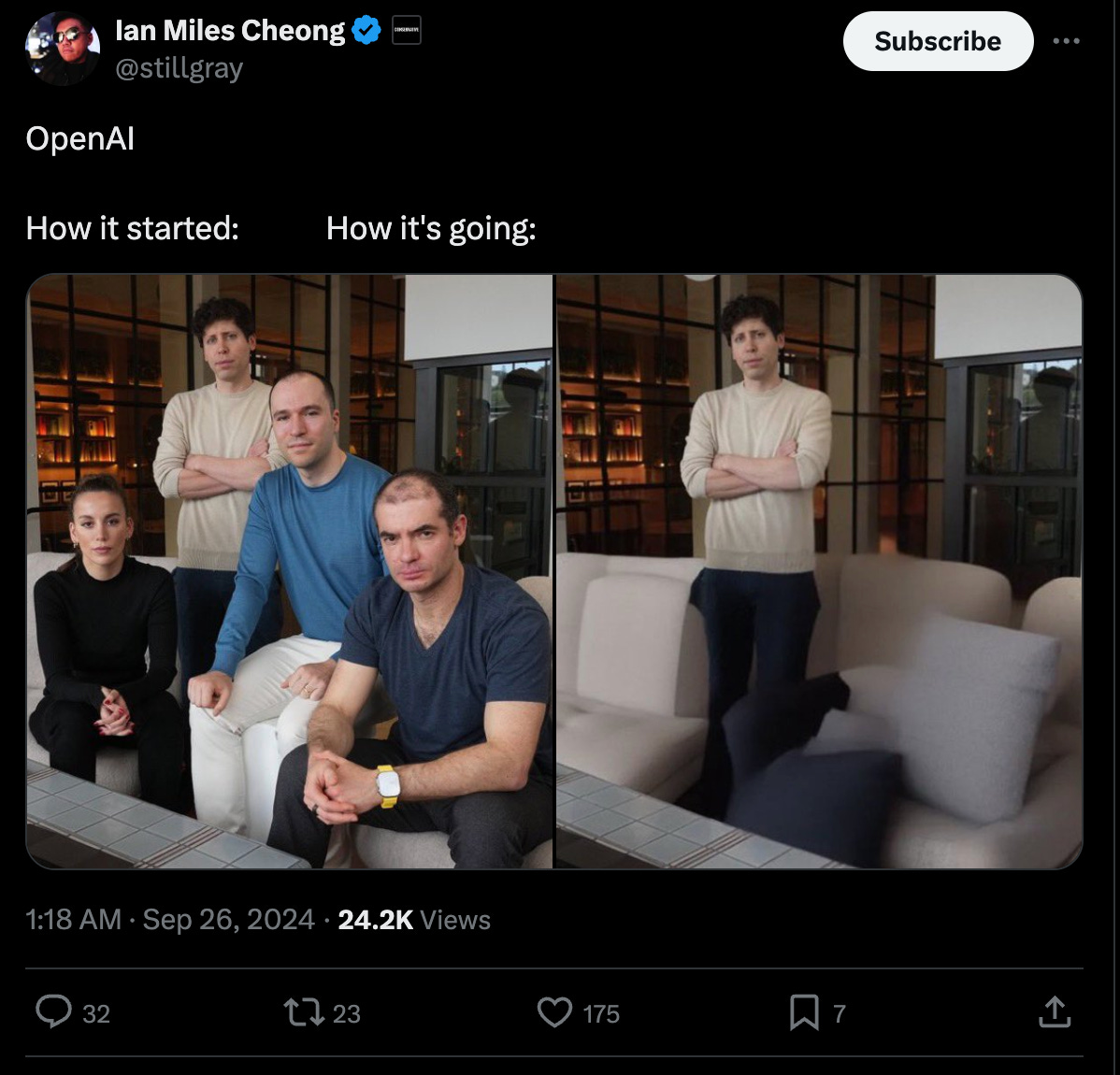
All of this is without even considering the turmoil going on within the leadership at OpenAI. With almost every co-founder and senior executive having departed in the last 12 months, the company, at least from the outside, seems to be in more disarray than ever. This, along with the complex unwinding and corporate restructuring from Non-Profit to For-Profit, needs to happen. It's one of the conditions for the latest fundraising round. All of this is likely to create all kinds of new challenges. If you need more context, here is a diagram that shows what I am talking about. OpenAI also has a blog post that explains it.
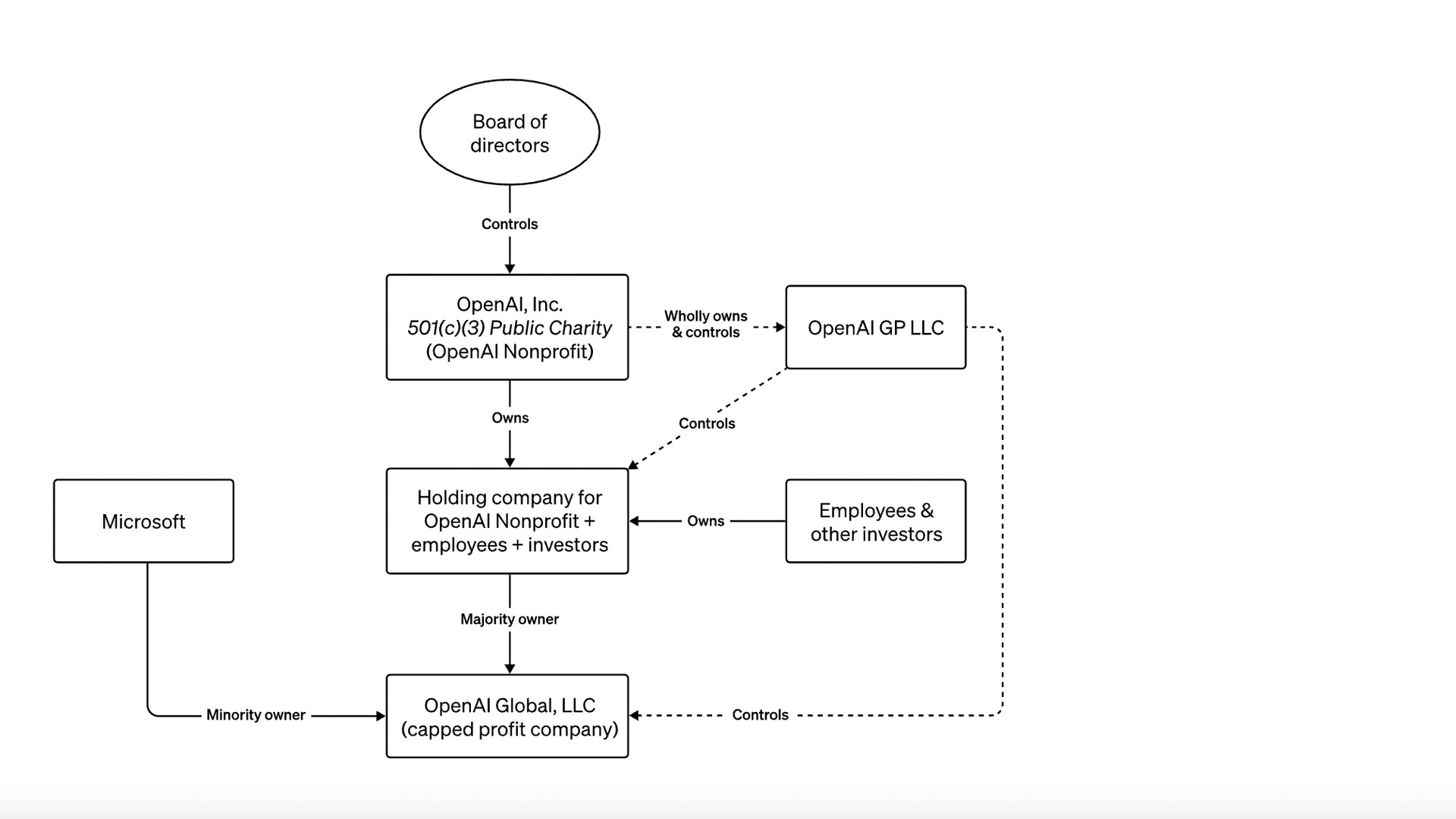
The long short of it is that it's a needlessly complicated, extremely opaque corporate structure that investors are demanding be unwound because of the covenant that makes it a capped profit structure as compared to a much more lucrative uncapped structure. This is the same corporate structure that led to Sam Altman’s brief ouster last year from the company due to “not being candid” with the OpenAI nonprofit board. OpenAI is likely to disband the Non-Profit board and move to a structure similar to that of rival Anthropic, which is a Public Benefit Corporation, a for-profit company with a defined goal that is aligned with the “public good.”
All of this also comes along with the news that Apple earlier this week made a last-minute decision not to invest in this latest round, with SoftBank having to step up instead. This is despite Apple making a big splash earlier this year when, at their World Wide Developer Conference, where they announced a huge partnership with OpenAI for outsourcing certain queries from Apple Intelligence on IOS to ChatGPT.
It isn't exactly the glowing vote of confidence the market is looking for when someone who is supposed to be one of your biggest partners in the near future suddenly decides they don’t want to invest, especially when its an organization as cash-rich as Apple, for whom that amount is likely a rounding error.
For OpenAI, this latest round is likely not its last. The only path to profitability and not having to rely on external funding and equity dilution is to take a step back from model development to build the next game-changing product that can extract more money from consumers and enterprise customers than they're already paying. Doing so, however, is likely to cause them to fall behind in model development and start to harm their only cash cow, ChatGPT, and the API platform. It is a Catch-22 at the heart of the company and one that I believe will begin to play more of a part in shaping the future OpenAI ends up having.
I am really excited to be writing again regularly, especially about stuff like this. But obviously a little nervous too. I’d love to hear what you think of this so please share your thoughts, either in the comments below or feel free to shoot me a message. Either way, thanks for being here and reading.
A special thank you to Vishwesh Desai and Shailendra Raj Mehta for reading drafts of this.
Great article. Looking forward to the next one!