


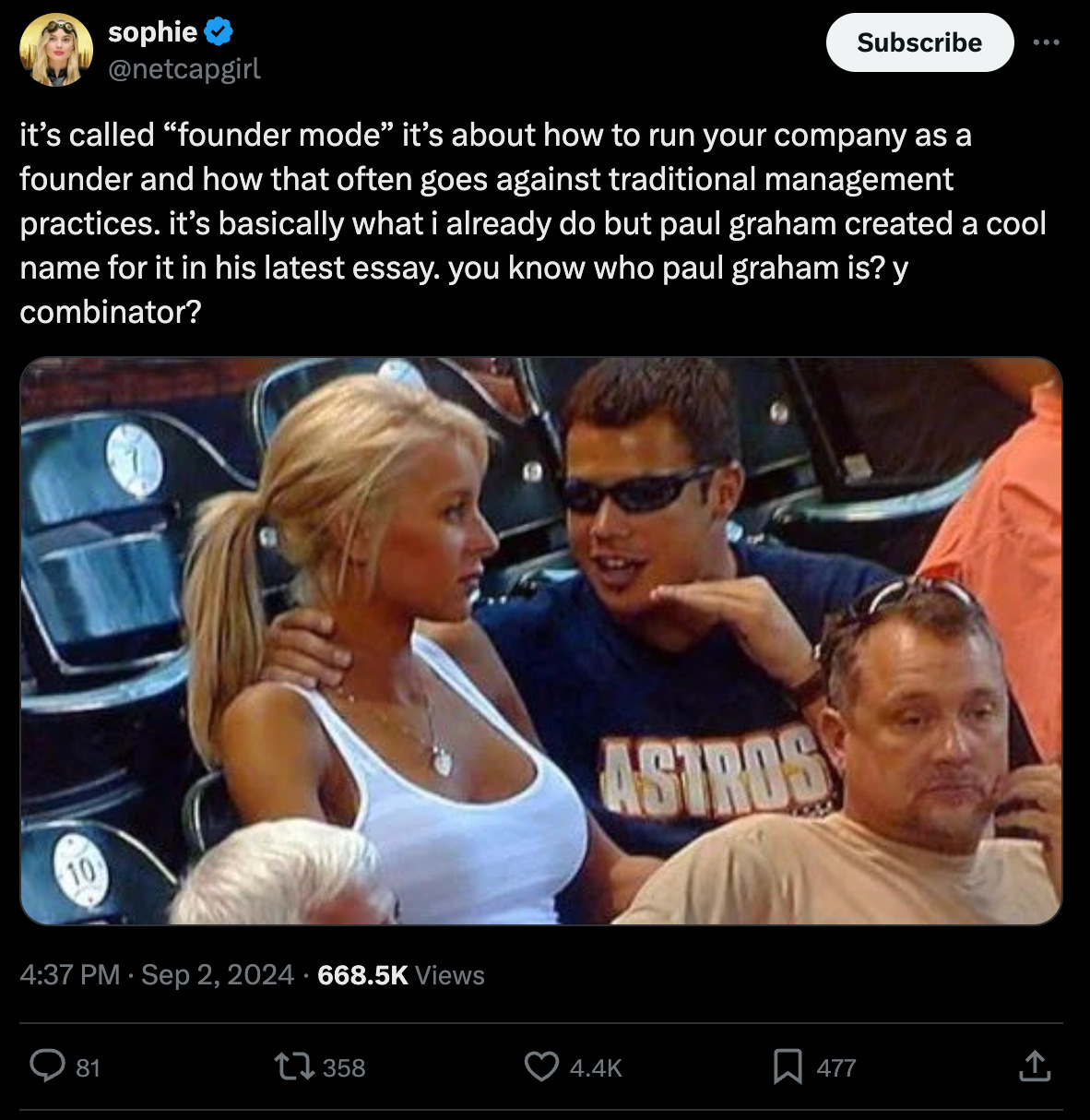
Paul Graham's latest essay, Founder Mode, became a huge conversation and instant meme in Silicon Valley and tech Twitter. It champions the idea that founders who take contrarian, high-risk bets can achieve outsized returns and impact. While success stories like Elon Musk and Mark Zuckerberg exemplify this approach, Snapchat presents a compelling case study of "Founder Mode" gone wrong.
Snapchat's Origins and Unique IPO Structure
Founded in 2011 by Evan Spiegel, Bobby Murphy, and Reggie Brown, Snapchat revolutionized social media with its disappearing photos and messages. The company's 2017 IPO was groundbreaking, introducing a share structure that gave founders unprecedented control:
Class A shares: Publicly traded with no voting rights
Class B shares: Held by early investors with limited voting power
Class C shares: Controlled by founders with ten votes per share
This structure effectively nullified shareholder voting rights, a first in public market history. While dual-class shares aren't new, Snapchat's approach went further by eliminating independent oversight and board control.
The Consequences of Unchecked Founder Control
1. Compromised Corporate Governance
With founders wielding absolute control, Snap's board of directors became largely ceremonial. This lack of genuine oversight removed a critical layer of corporate governance, potentially leading to unchecked decision-making and neglect of stakeholder interests.
2. Destruction of Shareholder Value
The impact on shareholders has been severe. An investment of $1,000 in Snap shares at IPO would be worth only $540 five years later, despite the broader tech sector experiencing significant growth during this period.
Snapchat Software Stagnation
1. Fierce Competition
The social media landscape has become increasingly crowded and competitive:
Instagram's introduction of Stories, a feature similar to Snapchat's core offering, has ate into Snapchat's market share.
TikTok's explosive growth has captured much of the young demographic that was once Snapchat's stronghold.
Established players like YouTube continue to innovate and expand their offerings.
2. Monetization Struggles
Despite its large user base, Snapchat has struggled to monetize effectively:
The ephemeral nature of Snapchat's content poses challenges for traditional advertising models.
The platform's younger user base may be less receptive to certain types of advertisements.
Snapchat's ad targeting capabilities may not be as sophisticated as those of competitors like Meta and Google.
3. Innovation Fatigue
While Snapchat was once known for its innovative features, it has struggled to maintain this reputation:
Many of Snapchat's unique features have been copied and sometimes improved upon by competitors.
The company's forays into hardware, such as Spectacles, have largely failed to gain traction.
There's a perception that Snapchat has failed to introduce truly game-changing features in recent years.
Snapchat's Failed Hardware Ventures
Snapchat's unconstrained "Founder Mode" is perhaps most evident in its ill-fated hardware initiatives. Most notably due to the founders recklessly pursuing ideas in a manner that dooms them before the project can even get off the ground.
Pixy Drone
Launched in April 2022, the Pixy drone was discontinued within four months after selling only 71,000 units. Issues included:
Safety concerns
Limited functionality
Poor user retention
Competition from smartphones
The project culminated in a total recall in February 2024 due to fire and injury risks.
Spectacles
Snapchat's Spectacles, launched in 2017, were arguably ahead of their time. However, they suffered from poor execution and failed to address key user concerns. Despite these setbacks, Snapchat persists with Spectacles, now in its fifth generation. However, the latest iteration still faces significant hurdles:
Limited availability (developer-only subscription model)
Experimental nature and niche target audience
Ongoing battery life limitations
Narrow field of view for AR experiences
Basic software and limited applications
High cost for developers ($1,188 for the first year)
Lack of compelling use cases
Snapchat Spectacles vs. Meta Ray Bans
Snapchat's approach to AR glasses stands in stark contrast to Meta's Ray-Ban smart glasses. While both products share similarities, Meta's offering has gained mass appeal, whereas Snapchat's has struggled to find its footing. Here is how Snapchats offering compares -
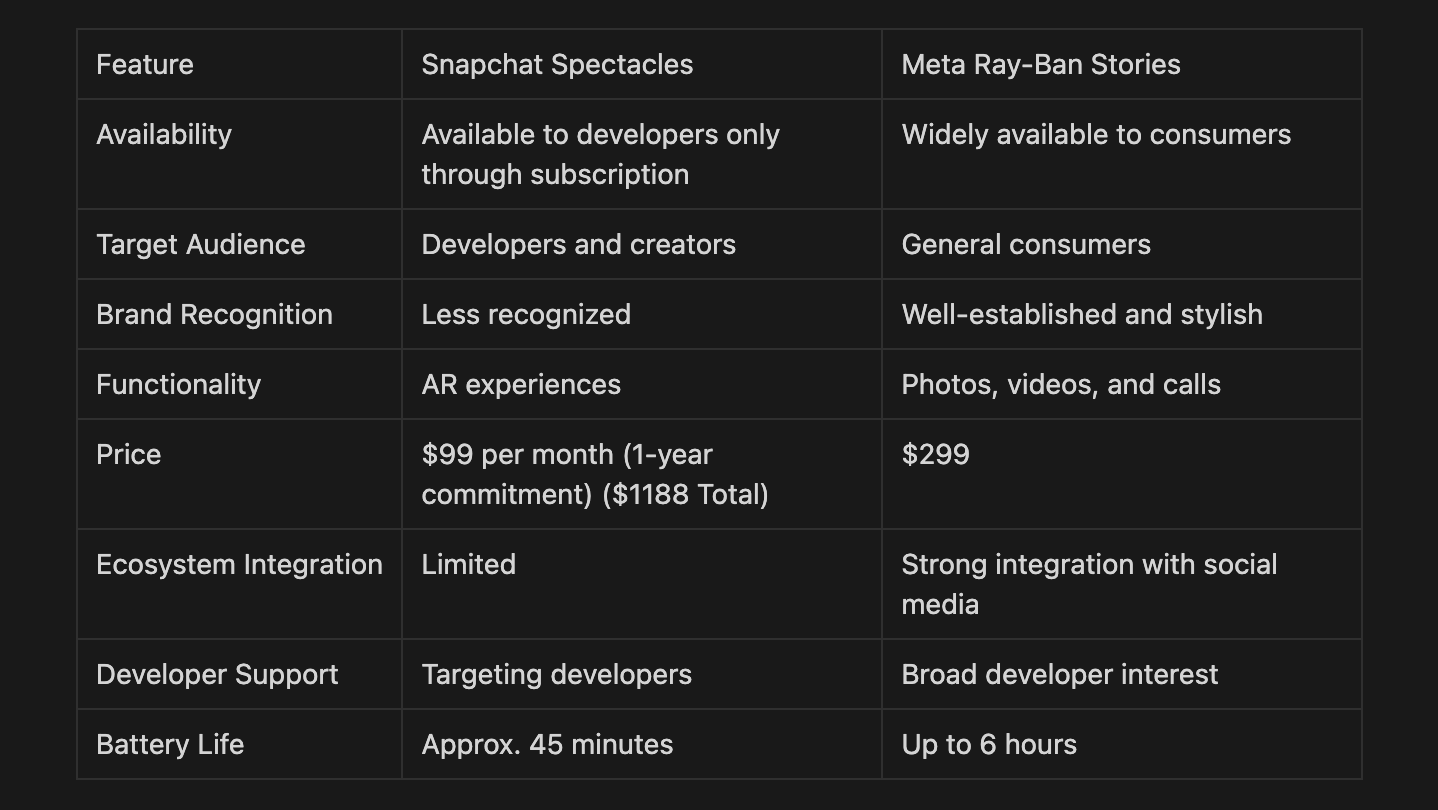
Snapchat, rather than focusing on consumers, is attempting to attract developers by scrapping its consumer-oriented Spectacles offering entirely. This appears to be a long-term strategy to build a developer ecosystem before relaunching the product to the public. However, even with this approach, they've made a significant mistake by charging developers for the kit. While easily correctable, it's unlikely to be addressed due to the CEO's overly optimistic view about demand for his product.
The core issue likely stems from a delusionally optimistic view about consumer and developer interest in Snapchat's products. The company's decision to charge developers while not offering the product to consumers is a significant misstep. Ideally, top AR developers should receive the product for free, enabling them to create apps that consumers want to use on the device. The only way to drive meaningful traffic to a new product, especially one in a unique category, is by fostering meaningful apps. History suggests that these apps are unlikely to come from an internal team. Snapchat is attempting to emulate Apple's approach to developers without possessing Apple's brand value, power, or recognition. It's an incredibly misguided strategy, chasing short-term returns rather than building a community around a product that could if developed correctly, be the next iPhone-level device or interface.
Potential for Recovery?
Despite these challenges, Snapchat still maintains significant strengths:
Large User Base: As of March 2024, Snapchat boasts over 800 million monthly active users, demonstrating its substantial reach.
Strong Daily Engagement: The platform's 422 million daily active users indicate high user loyalty and consistent interaction.
Growing Subscription Service: Snapchat+ reached 9 million subscribers worldwide in 2024, pointing to promising new revenue streams.
Expanding Global Presence: The platform has experienced significant growth beyond North America and Europe, with 235 million users in Q2 2024.
To Founder Mode or Not to Founder Mode
While "Founder Mode" can drive innovation and success, Snapchat's story serves as a cautionary tale of unchecked founder control. At Snapchat, this approach has led to significant value destruction and missed opportunities to create what could have been a generational company. Despite having all the ingredients for success and an incredibly sticky core product, Snapchat's lack of accountability and excessive founder control have transformed what should have been at least a $100 billion company into one that has stagnated and declined—during a period when capital markets were arguably more friendly to tech companies than ever before.
The "Founder Mode" essay sparked considerable debate on tech Twitter, likely because founders are often polarizing, delusionally optimistic and bold, However, when paired with hubris or unchecked power, this mindset can lead to outcomes like Snapchat's. Many venture capitalists, perhaps rightly so, worry that "Founder Mode" might become an excuse for reckless decision-making or, in Snapchat's case, executing smart ideas in misguided ways. I suppose in the grand scheme of things the concept of "Founder Mode" is just the latest example of the tech industry's ongoing struggle to balance visionary leadership with responsible governance.
Time will tell.